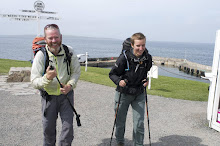
The Road goes ever on and on; Down from the door where it began;
Now far ahead the Road has gone; And I must follow, if I can;
Pursuing it with eager feet; Until it joins some larger way;
Where many paths and errands met; And whither then? I cannot say.

[JRR Tolkien, Lord of the Rings]

Monday, 18 February 2013

Scotland - Day 8 (Dallas Dhu and the Findhorn)

What had started as a suggestion of a walk sometime whilst we were up in the area had grown into an offer of dinner and an offer of a nice flat driveway on which we could park Colin for the night, and so it was that we spent an excellent evening on Saturday eating, drinking and chatting with Louise & David until, with midnight upon us, off we toddled back to Colin.

Louise had made a number of suggestions as to where we could walk on Sunday and the option that she picked was a circuit starting from Dallas Dhu distillery.

We were a little behind ourselves in setting out, as by the time we had completed the obligatory faff around the car boot, it was 10.45, against an intended 10am start. Louise blames that on the chatting in her kitchen before we hit the road, but there was also the delay whilst I borrowed a screwdriver to take one of Colin’s seats apart so that I could retrieve an expensive electronic item that I had dropped down the back (and, incidentally, a DVD, which I had dropped down there on a previous trip)!

With the car-boot faff completed and having established that wherever my hat was, it wasn’t anywhere about my person or in the car, we headed away from the distillery car park. Onto estate tracks we went and past some interesting buildings, including this one which, whilst entirely out of place, would look magnificent if it was taken back to its former glory:

IMG_2708

The estate tracks took us into woodland, where Louise managed to pick the correct tracks out of the plethora which existed there, to lead us up to follow the River Findhorn. There were some excellent views down to the river, but none of the photos I took do it justice at all. Mick put himself into something of a perilous position at the top of some cliffs to take this one:IMG_2713

Louise not only planned and led the walk, but she catered for it too. Elevenses had us drooling over the cake that she provided and she was even good enough to give us rolls for lunch which were furtively eaten when we stopped outside a tea room for coffee:

IMG_2714

I took this snap of us drinking coffee, but failed to take one of the rest of the attractive courtyard in which the benches were set.

The track we needed after lunch proved a little elusive, until we found it exactly where Louise thought that it was. It led us, after a short while, onto the disused railway line which is the Dava Way, which afforded views to Findhorn Bay and the hills beyond (I now know that the pointy one on the other side of the bay is Morven).

During afternoon tea-break (not to mention some more excellent home-baking provided by Louise, this time in the form of chocolate and ginger flapjack (yum!)), Mick once again proved that he knows half the population of the area when the only person who passed us during that break turned out to be another ex-colleague, who stopped for a wee chattette.

Suitably refuelled by tea and cake, away from the Dava Way we went, back onto estate tracks and past another interesting, but abandoned, building. Strangely, this one doesn’t seem to have an entrance at all:

IMG_2717

Barely a hop and a skip later, after a standing stone and an osprey nest, we were back on tracks that we recognised (having formed the outward route).

The legs were feeling verily exercised after 13ish miles of walking with around 1500’ of ascent. My considered opinion is that Louise had planned the perfect walk, with views, a river, more views, interesting buildings, lovely woodland, a cafe half-way and, most importantly, a good supply of home-made cake. image

Scotland - Days 6 & 7 (Elgin)

Days 6 and 7 saw us leave Braemar to head north to visit friends, starting in Elgin, where Frank & Hilda not only put us up and put up with us, but Frank also took us for a stroll along the coast from Hopeman to Burghead, complete with a pair of binoculars.

Frank is a knowledgeable man when it comes to birds and he pointed out various sea ducks to us (plus the fulmars which apparently shouldn’t be there at the moment). He was managing to identify some with his naked eye, which I could barely even made out as a dot on the sea – I’m not sure how much of that is indicative of my lack of knowledge of birds, and how much is due to my need to get a new prescription in my glasses!

Anyways, we had a lovely walk, in good weather, out to Burghead* where we did a little circuit of the headland before heading back the way we had come (the way back was in the company of two grumpy old men; Mick and Frank can’t half put the world to rights!). It was 4.75 miles of walking with barely a jot of upness.

After a night with Frank & Hilda (thank you F & H Smile), we just had a short journey to visit Louise & David and, with a little bit of time in hand, we thought that we would just nip over to Findhorn and take a short wander around the headland there.

It now seems to me that Mick knows half of the population of the area, as out of the first three couples we passed on that stroll, Mick knew two. It was the third, who approached us with the exclamation of “Well, if it isn’t Mick!”, with whom we stood and chatted for quite a long while, until the sun was dipping down and the day getting cold. It was a good and enjoyable reason to curtail a walk, but we still had time for a very small circuit before we headed back to Colin to continue our journey.

As the sun went down, we had to hope that the weather would hold for another day…

(*There would be a photo from the Burghead walk if I hadn’t been stupid and wiped the memory card!)

Thursday, 14 February 2013

OMM Kamleika Smock

A few days ago Katy left a comment to ask what I thought of my OMM Kamleika jacket, which happens to be the only waterproof jacket that I have with me, thanks to something of an aberration when we left home for this trip.

First off, I should clarify that it’s not the jacket that I have (even if I call it a jacket) it’s the smock, and I bought it with two purposes in mind. Firstly, because, as much as I love my Paramo jackets, I don’t trust them to keep me dry in the wettest of weather, so, on backpacking trips, I like to carry something very light and waterproof as a back up. Secondly, I was after something very light to take on our PCT jaunt, where it was unlikely to rain more than a few times (as it went, we didn’t even see a rain cloud in our five weeks, never mind get rained on).

It’s not a highly featured jacket. It’s got a narrow cut, a hood that isn’t quite long enough for my long neck, a very deep two-way front zip and one chest pocket. The cuffs are elasticated, without any adjusters, but they do have thumb loops.

And how have I found it? Well, it’s very light (225g for my size small), which is my main requirement as I have carried it much more than I have worn it.

Being made out of a soft, stretchy material (not a hint of crisp-packetness about it) it’s as comfortable to wear as a sweater, but I can’t say much about its waterproof or breathability qualities because I’ve only worn it in the rain a couple of times (one of which was monsoonal) and I would be surprised indeed if a waterproof jacket didn’t keep my dry on the first few times it got wet.

The real test will be that of durability and it’s going to be a while until I can comment on that.

So, sorry Katy, not much of a review I’m afraid!

Scotland - Day 5 (Braemar)

What a surprisingly good day of walking that was!

The temperature rose last night. By 9pm the snow which had been falling all day turned to rain and by morning the thaw was obvious. The sun was out too and it was looking to be a lovely day, albeit a bit on the breezy side.

Without any real plan, we left the campsite on foot and headed in the direction of Invercauld Bridge with the thought of a walk through the woods there. There’s a perfectly good and easy track, running under the Lion’s Face, which we could have taken to get ourselves over to the A93, and indeed we did take it to just before the Lion’s Face. At that point, with a rush of blood to the head, we opted not to follow that perfectly good and easy track as it went gently around the hill, but rather to go up and over the shoulder. All good training for our unfit limbs, but with the snow being knee-deep, wet and heavy we opted not to go any higher up the pathless hillside in our explorations today.

Mick, Tree, Blue Sky

Having entered Ballochbuie Forest at Invercauld Bridge, I was afraid that a walk there wasn’t going to be particularly interesting, but I’m pleased to say that I was entirely wrong. It’s a lovely woodland and the higher of the tracks that we took was not at all hemmed in, but gave fantastic views of the surrounding white hills, only the tops of the highest of which were in cloud today.

By the time we had dropped back down, to pass an log cabin in a lovely location, my legs were starting to protest at the effort of all of the snow walking. The legs protested even more as we climbed back up to the Lion’s Face on our return to Braemar, but focussing on the hot chocolate that awaited me stopped me from whinging too much!

I forgot to take the Garmin Gadget today, but having plotted a rough approximation of our route on the map it looks like we walked at least 9.25 miles with 1800’ of ascent.

Wednesday, 13 February 2013

Scotland - Day 4 (Braemar)

“It’s snowed!” I exclaimed as I peeked out the window first thing this morning. It was, however, just the slightest of dustings and things were looking good for a walk in the woods (the forecast of winds gusting to 85mph putting us off the thought of high ground today). Up I sprang and put the kettle on ready for a mid-morning start.

By the time tea had been drunk the weather was not looking conducive to a day outside. Suddenly more cups of tea and finishing our books looked like a better plan, with perhaps a stroll in the afternoon.

Books were finished, tea was drunk, lunch was eaten and more tea was drunk and finally we hit that time of day where, if we didn’t venture out, we were going to find ourselves spending the entire day lounging. The duvet was duly stowed, and out we went into the snowstorm.

It wasn’t bad out actually! The snow got heavier as the day went on, but the forecast winds weren’t in evidence. Accordingly, we opted not to head over to the forest at Invercauld, but to head up the little lump of Creag Choinnich.

From the point at which we made that decision, rather than traversing the hillside to find the path, we opted to take the most obvious route of going straight up. Good fun it was too, often wading through knee high drifts (and once finding myself rather surprised to sink to the hip). Quite a sweat was worked up but by and by we made our way to the top.

The views would probably be excellent on a clear day, but today it was white against white with white falling. We didn’t tarry too long, but followed in everyone else’s footsteps in taking the path down, through the woods, into Braemar. We met a chap just off the top; he looked quite cold:

Snowman

Back down in town, we were as near to the campsite than we were to the centre, but Gordon’s Tea Room was calling us so we diverted off to answer that call. If I had remembered to turn the GPS off before we went inside then there wouldn’t be the wandering bit at the end of this track:

Braemar Map

It was only just over 2.5 miles of walking and a modest 500’ of upness, but it was undoubtedly good fun and a reasonable amount of effort.

Tuesday, 12 February 2013

Scotland - Day 3 (Braemar)

We had two possibilities in mind as we set out this morning. With the weather forecast being the best of the week, one of the options was to go up Creag nan Ghabhar, a Corbett just east of the A93. The other option was to simply walk a few miles up the glen to Loch Callater and back. As both options shared the same first mile an immediate decision wasn’t needed and up the glen we headed.

“You’re the birthday boy, so you get to choose” I said to Mick when we reached the junction of tracks.  The low route, he decided, maybe based on the tired legs, left over from yesterday’s efforts, or maybe based upon the unappealing look of the uphill option, with white hillside camouflaged against the white sky. It was not quite the weather that the forecast had suggested (indeed, the ‘occasional snow flurry’ turned out to be a constant very light snow, from heavy white skies, for most of our outing).

Underfoot today, the snow was even more powdery and soft than yesterday. It was like walking 7 miles across sand dunes. Ankle shaping, some would say. Certainly harder work that the gentle track should have been.

Having admired the frozen- and snowed-over Loch Callater, and having dismissed the notion of walking a circuit around it, into Callater Stables bothy we went for a bit of shelter for lunch. It was Red Leicester (the last of a Christmas Cheese Hamper present) with the rather-odd walnut and ginger chutney on our sandwiches today.

Callater Lodge

The view, towards the Loch, from beside Callater Stables

The return journey simply retraced our steps, with occasional views of yesterday’s hill, Morrone, as we went. Such was the soft powderiness of the snow and the very gentle gradient of the track that the return journey wasn’t an awful lot easier than the outbound one. Skis would have been handy!

Still, it was another good stretch of the legs and an enjoyable outing. It will be interesting to see the same glen again in different conditions when we head up there on the TGO Challenge in May. Hopefully it will be a little easier going then – and hopefully we’ll be a bit fitter too.

Monday, 11 February 2013

Scotland - Day 2 (Braemar)

Call us unimaginative if you like, but when the day dawned far nicer than forecast, we decided that Morrone seemed like a good objective. The top, this time, not just some random point half way up.IMG_5084

As an added bonus, we could see the top today, albeit it was a bit white-on-white.

A different route was taken, first heading along a minor road to the south for a few kilometres, so that we could take the navigationally easy option of following the track that heads all the way up to the summit. The snow that had fallen on us yesterday had become heavier overnight but even the extra few inches on the ground couldn’t obscure the line of the track.IMG_5090

See, it’s obvious, innit?

Navigationally things may have been easy, but the going underfoot was sometimes arduous – particularly through the deeper drifts.IMG_5093

No drift at all here, but I’m surprised at how many blue-skied shots we have of the day. I don’t remember the blue sky, and it was only a few hours ago!

IMG_5095

That was one of the deeper sections and it was hard going for my unfit legs! It was steeper than it looks in that photo.

I was desperate for a sit down, a cup of tea and a bite to eat by the time we were a mile short of the summit, but by then we had lost the shelter we had been enjoying and it was clear that the only sensible place to stop was in the lee of the buildings atop Morrone.

Eventually we finished our uphill snow-wading and made it to the top and the sandwiches were most welcome (although I’m not sure about the combination of both walnuts and ginger in a chutney). Being hit full in the face by a snowball (launched at me by the roof of the building behind which we were sheltering, when the wind shifted) suggested that it was time to move on and in the absence of any hint of a path from the summit (nor indeed any other bootprints) we just headed off in the general direction of Braemar.

IMG_5100

Not the most attractive summit, but the lee of the buildings was a good place for lunch.

It had taken us just over three hours to reach the top (in fact, so slow was my ascent that the GPS gadget spent much of the time auto-paused; I should have learnt by now that I need to disable the auto-pause feature before tackling hills), but it took us less than an hour to get back down again. In the absence of any hint of a path we simply took a direct line.

Some of the snow was scoured, hard and icy. More of it was deep, soft and good fun.

IMG_5102

Goose-stepping? Doing the can-can?

We were about half way down when we finally encountered evidence that someone else had been on the hill today. In fact, it seemed that a few people had made it to the half-way point before retreating. We didn’t follow their footsteps back down as in some places they hadn’t half taken an odd choice of line.

With thoughts of hot showers and hot chocolate in the front of our minds, we didn’t tarry as we passed through Braemar, but made a beeline for Colin.

In retrospect, it was a jolly good day out. For three quarters of the day, my feeling was that it was just jolly hard work!

The circuit was 8.5 miles with somewhere in the region of 1900 feet of ascent.

Scotland – Day 1 (Braemar)

After a busy week, our long drive and a late night, we weren’t feeling inclined to leap out of bed at the crack of sparrow’s on Sunday morning. In fact, we were still lounging around, just contemplating a third cup of tea in bed, when a text came through from Martin inviting us for a walk up Morrone half an hour hence. There was no chance that we could possibly get ourselves up, breakfasted and ready in that time frame, so another cup of tea was duly had.

Finally, at gone noon we did drag ourselves out, first to go and look at the selection of Paramo jackets available from Braemar Mountain Sports, and then to go for a little bit of a wander.

Our wanderings took us in the direction of Morrone and up seemed like as good a direction as any to head. I’m sure that the people we passed on the final stage of their descents wondered about our sanity in only just heading up at that time of day, but we were happy to just get as far as we fancied; the top was not necessarily our objective.

Now I should, perhaps, mention that it was a bit snowy. Not just underfoot, but from the sky too. Not only that, but it was a bit breezy. We were certainly glad that, in the final ten minutes before we left home on Saturday, I’d dashed up into the loft to find our goggles; they not only kept the snow out of our eyes, but they kept our faces quite warm in the biting wind!

IMG_5082

Just before we entered the cloud base, we concluded that the weather wasn’t going to get any better, the day wasn’t going to get any younger and that our legs had been sufficiently stretched for the first day of our holiday. An about-turn was made and back down we went.

4.4 miles were walked, with 1200 feet of ascent.

Scotland – Day 0

We were a little late leaving home for our journey to Scotland. We should have left on Friday morning, but that plan was hampered by Mick still being at work up in Oldham and by the time he arrived home on Friday evening, I was lying in a darkened room, whimpering softly, with a very poorly head. A new plan was set that we would leave home by noon on Saturday, which would give me chance to make all the final preparations (important ones, like baking a cake and making some flapjacks), which I had failed to do on Friday afternoon due to said poorly head.

We were only a few minutes behind ourselves when we did finally leave home. Time wouldn’t have been an issue if we had left home on Friday, as we would simply have broken the journey half way. However, with a forecast of snow for Sunday, we wanted to be at our destination before it hit, and thus needed to complete the journey in one go.

The journey was completed in one go and completely without incident. At 19.35 we pulled into the campsite at Braemar, some twenty five minutes before their ‘latest arrival’ time. Twenty minutes later, having filled Colin’s water tanks and plugged him into the mains, and having realised that I’d forgotten to bring either of my two key jackets with me, off we wandered into Braemar*.

We’d not gone very far when we bumped into Martin. Small world isn’t it? Admittedly, it wasn’t an entirely accidental encounter, as I had checked his website the evening before and found that, by coincidence, he and Sue were due to be in Braemar on Saturday night too.

They were staying with Sue’s friend Simon, who seemed completely unfazed at having two complete strangers turn up on his doorstep for a three-course dinner at very short notice.

An excellent evening was had and just as we were about to turn into pumpkins on the stroke of midnight, back we toddled down the snowy streets of Braemar to collapse into bed.

(*It was during the drive up that I realised that I’d forgotten to pick up my insulated jacket. “Not a problem” I said, “I can manage with just my Paramo”. It wasn’t until we arrived in Braemar that I discovered that my Paramo jacket was, rather unhelpfully, still hanging on a hook at home. That’s left me with just my ridiculously-lightweight OMM Kamleika as my jacket. Ooops)

Wednesday, 23 January 2013

PCT Food: Part 3 (Random Thoughts)

Here are 11 random thoughts as to food items that featured in our PCT trip:

1) Chocolate

Chocolate is a must on any of our long walks! Choice in the US was disappointing (particularly compared to the hundreds of branded and unbranded options that there are in the UK), but we could get Snickers, Kit Kat, Twix, M&Ms, Reeces and Hersheys. All of those came at a huge price, and Hersheys was out of the question anyway as (in my opinion) it’s the most disgusting excuse for chocolate known to man. Fortunately, we mainly bought M&Ms, which were available in huge packets, but we did also get some Snickers and KitKats.

M&Ms have the benefit of a sugar shell, but we soon realised quite how badly Snickers and KitKats fare in the desert, being solid only in the middle of the night. Snickers as pre-breakfast, at 4am, didn’t go down too well!

Later in the trip, I came to discover that eating a KitKat in the middle of the day was possible if using a spoon. It’s the only time I’ve ever eaten a KitKat with a spoon, and it was a surprisingly good experience!

2) Oreo Cakesters

Oreo Cakesters (they look like oversized Oreos, but the chocolatey bits are made out of cake rather than biscuit) are good! And they even taste nice when completely mashed, which is a good thing, as they really don’t travel well!

3) Pints of Ice-Cream

Obviously not something that we popped into our backpacks, but there’s nothing nicer than walking into a town, in approaching 40 degree temperatures, and to feel no guilt whatsoever in destroying an entire pint of ice cream.

4) Biscuits (or Cookies if you’re American)

In our original resupply shop in Los Angeles we really struggled to find things for puddings. The item that we found, which not only offered an excellent calorie to weight ratio but were also available at a reasonable price, was big 1kg packets of biscuits (think Oreos, but some were half chocolate half plain, and some were entirely plain). Fourteen biscuits fitted nicely, as two stacks, into a ziplock bag and they travelled really well. We did, perhaps, buy too many (mainly as they were one of the only items we found that wasn’t outrageously expensive) as, by the end of the trip, Mick couldn’t even bear to look at them. That said, I think that every single one got eaten.

5) Granola

On UK backpacking trips, breakfast is usually muesli or granola and sometimes porridge, but interspersed with a cooked breakfast in a greasy spoon or a B&B when the opportunity arises. On the PCT, in the absence of greasy spoons and B&Bs, granola featured heavily. Even though we had a good variety of flavours, by the end of the trip neither of us ever wanted to see a spoonful of the stuff ever again. In fact, there’s a box of muesli sitting in the cupboard at home that’s about to go out of date because we still can’t even bear muesli; must make it into some flapjacks to save wastage!

IMG_2268

All foods mentioned in this post, except for the ice-cream, are on that table and chair.

6) Gatorade

I attribute no small part of the success of this trip on Gatorade! It’s available in US supermarkets in powdered form and we drank one bottle with breakfast, one with our evening meal and sometimes (if we had enough powder) one with lunch too. Extra calories, a very pleasant change to plain water, and allegedly good for electrolyte balance when walking in such a hot place. We ended up throwing all of our tea bags away, as the Gatorade took the place of our usual cups of tea.

7) Stock Cubes

I’m so pleased that I took along a selection of stock cubes as, when I finally remembered that we had them with us, they did improve our meals.

8) Olive Oil

Olive oil was carried purely for the extra calories. We didn’t need as much as we carried, as we kept forgetting to use it, but once I did get into the swing of adding a glug to every meal it worked out fine. 

9) Minute Rice

Why can’t we get Minute Rice (an instant cooked, dried rice) in supermarkets in the UK? Surely there must be a market for it? If we could, then I really don’t think that I would go to the bother of cooking and dehydrating my own.

10) Fish & Biscuits! (and a mention of Noodles)

We didn’t get our trail names for nothing, as fish and crackers featured quite a bit in our diet. In fact, more than usual, as the opportunities to buy cheese were so limited. The fish options were good. I clearly remember the joy of kippers and oat cakes, which seemed somewhat out of place as a meal to have in the desert! Noodles also featured quite a bit, but Mick ended up eating more of them than me, as never have I had such bad and long-lived indigestion as when I had noodles for lunch (don’t know why; I’ve eaten noodles since with no issues).

11) Food Shopping In General

What really surprised us about the food was the price of it. Eating out was cheap, yet supermarket shopping was expensive and (in some product lines) surprisingly lacking in choice. I can see why eating out is so popular over there – it’s just a pity that there were so few (well, strictly speaking, none) restaurants on our route.

Monday, 21 January 2013

PCT Food: Part 2 (The Resupply Strategy)

As I already mentioned in Part 1, the section of the Pacific Crest Trail (PCT) that we walked is one of the more remote parts with limited resupply opportunities. Even where we visited some form of civilisation where it was possible to receive a parcel, few had any significant grocery shopping facilities. In fact, only one of our planned resupply points boasted a large supermarket.

It was information gleaned from the PCT Handbook, on the subject of resupply opportunities, that guided our resupply plan. Maybe it was purely a matter of lucky timing, but reality turned out to be somewhat different from the information upon which we had based the plan.

The Plan

Our intended resupply plan was as follows:

image_thumb2

It’s Lake Hughes, not Lake Huges, but I’m not re-doing that table just to insert an ‘h’. It also appears that there was a severe shortage of apostrophes when I put it together.

The Reality

As it turned out, we could easily have resupplied from shops as we went along.

The petrol station in Lake Hughes was very poorly stocked and I really struggled to choose even two days’ of food, but Mojave, as we knew it would, boasted a big Safeway where we were not only able to get everything we needed for the following week, but we had choice too.

When we got to Walker Pass (and having failed to get a hitch into town) we ended up getting a lift to the Post Office in Onyx (there’s nothing in Onyx except for a Post Office) with a trail angel who was continuing into the town of Lake Isabella. We went with her and ended up visiting a couple of big supermarkets, so we could easily have shopped instead of sending a parcel. It was the prospect of a 70-mile round hitch (not that I relished the 35 miles to Onyx and back!) that had put us off including Lake Isabella as a resupply stop.

The Handbook warned that the Kennedy Meadows store (where everyone goes) may have been cleared out by those who arrived before you as it’s only a small store. As it went, there was impressive array of food available and, because pretty well all PCTers stop there, it’s very much focussed on backpacker friendly food. We could easily have bought there.

Likewise, because Vermillion Valley Resort is so remote (I seem to recall that it’s 70 miles away from a shop), they don’t get to re-stock too often and thus it’s not hailed as a reliable resupply point. We not only found it well stocked, but it was whilst we were there that we changed our plans to go into Mammoth, which meant that we only needed a day and a bit of food, not the 4 days that we’d sent.

Mammoth was the easiest hitch of the trip, and it would have been even easier from a logistics point of view if we’d been a day later, when the shuttle bus started running. We didn’t visit the supermarket in Mammoth (as it wasn’t an intended stop, we already had enough food to see us through), but if we had wanted to then a free shuttle bus would have taken us there and I’m sure we wouldn’t have struggled with buying 2 days’ of tasty fresh, heavy stuff to get us the last hop and skip to our destination.

Day 31_1

Random food photo

What I’d do differently

Even though it transpired that we could have resupplied on the way, if we were to do the trip again (or, indeed, any other long walk in the USA), I would still go down the same route of buying dehydrated ingredients.

Why? Three reasons:

1) Because I didn’t find a single packet meal in the supermarkets that I would actually want to eat, and certainly not for five weeks. We did buy a few packet meals (pasta and sauce, noodles, cous cous – the usual fayre) and the noodles and cous cous were fine – for a snack or a minor meal, but I just can’t consider them to be a main meal, day after day. As for the commercial ‘pasta and sauce’ meals – urgh!

2) Being a non-meat-eater, my options would be severely limited if I was buying supermarket packet meals.

3) I like to feel like there’s some nutrition in my meals, and I just couldn’t feel that way if eating commercial, processed packet meals every day.

However, I wouldn’t mail breakfasts, lunches and snacks if there was the prospect of reasonable grocery shopping en-route. We would have managed just fine to pick up something for these meals as we went along (and if we had bought as we’d gone we wouldn’t have had the incident of the granola that got too close to the washing powder in transit, resulting in heavily perfumed granola, which we had no choice but to eat by the time we found out that it had been tainted!)

Even though I would use dehydrated ingredients again, I would do it differently next time. I would buy a slightly smaller array of ingredients (but only so as to avoid the crunchily raw ones), and I wouldn’t make them up into meals in advance. Instead, I would just bag up the individual ingredients, together with a stash of various flavours of stock cubes and bags of seasonings (including sachets of powdered ready sauces such as chilli and bolognese) and I would make up meals according to our fancy as we went along. Whereas usually our meals would have the emphasis on the veg/bean/meat element, with the rice/cous cous/mash/pasta as an accompaniment, in using commercial dehydrated ingredients in the future I would change the emphasis so that the bulk of the meal would be the carb element, with the ‘topping’ playing a lesser role. I would still feel like I was getting some nutrition, but with the filling comfort of having more stodge.

-------------------------

Now, I think that rather thoroughly answers Geoff’s original question, but I’ve still got one more post to go on the subject, just to cover a few other random thoughts on the foods we ate.

Sunday, 20 January 2013

PCT Food: Part 1 (The Evening Meals)

Geoff got in touch with me last week to ask how our food strategy on the Pacific Crest Trail (PCT) had worked out, which has chivvied me, rather belatedly, to gather my thoughts on the subject*. It may have seemed like a simple question, and Geoff was probably expecting a brief answer, but I have once again demonstrated a complete inability to be succinct, and have therefore written three posts around the subjects of food and resupply on our PCT trip.

Background: For our backpacking trips in the UK, we always cook and dehydrate our evening meals before we set out, but buy most of our breakfasts and lunches as we go along. That approach wouldn’t work for an American trip due to food import restrictions (although there are some things you can take). Had we been walking a route with easy buy-as-you-go resupply opportunities, then we probably would have just bought as we went. However, the section of the PCT we chose is one of the more remote parts and the PCT Handbook told us that the places that could be relied on to provide resupply were few and far between.

I vacillated at length between buying commercial processed packet food in a supermarket on arrival in the US, or buying dehydrated ingredients. Either way it was going to be posted ahead.

Harmony House Foods: Eventually, having decided that I wanted both a bit of variety and a bit of nutrition over the course of our five weeks of walking, I came down on the side of dehydrated ingredients, and considered a number of suppliers. After much perusal of their websites, Harmony House Foods was selected as they offered almost all of the ingredients that I wanted in air-dried (rather than freeze-dried) form.

Deciding how much we wanted of each ingredient was tricky. We didn’t have the ability to experiment, so I took my knowledge that each of my home dehydrated meals come in at around about 100g in dry weight, except for pasta sauce which (being mainly tomato based) comes in at nearer 75g, I listed the ingredients for each meal that I wanted to create (a spread sheet was involved, as you’ll see below, but no graphs, I promise!), and made an educated guess as to the proportions of each ingredient.

image

image

In the absence of meat, I also bought various flavours of fake meat to add to Mick’s meals, but that didn’t make it onto the ingredient list

On arrival in LA, our food was all waiting – and there was masses of it. Even after splitting it out and mixing it up into bagged meals (tricky without implements, measurers or scales), we could have no idea how the quantities would work out.

IMG_2263

Evening meals for 4 weeks.

The two pieces of paper on the top left of the table were my print outs of the spread sheet, so that I knew what I was doing with all of those ingredients!

More worrying, however, was whether the meals would prove to be palatable. Once they were all bagged up, we couldn’t help but notice that there was an awful smell of ‘dried vegetables’ emanating from the parcels, and if they tasted like they smelt then it was going to be a culinary disaster of a holiday. Another worry on the palatability issue was something that hadn’t occurred to me until we got to LA: when we dehydrate meals at home all of the ingredients are cooked first; the bought pulses were cooked, but the vegetables were all raw.

image

I divvied up the tomatoes first…

It was with great relief that we mixed up our meal on the first day and found that it was edible. Admittedly not what you might choose to eat if you were at home, but it was tasty enough. I wouldn’t call that first meal a real success though, as it was rather crunchy and the later intense intestinal discomfort added to what had already been a very challenging first day.

That first meal taught us two things:

1) Even if the meal looks to be rehydrated after fifteen minutes, it’s best left for far longer; and

2) Some dehydrated raw ingredients work better than others.

From Day 2 our meals became more successful. The routine became that we would in a shady spot for lunch (lunch during the first 3 weeks being a break of between 3 and 5 hours, depending on how unbearably hot it was), pop up the tent as insect protection, boil up some water and put the food on to rehydrate. We would then kip/read/blog/watch the world go by from the comfort of the tent for an hour or so, then I would venture back out to the stove and bring the meal back up to boiling point, add the rice/pasta/cous cous, and leave it for another ten minutes (if we were having smash, that was added when we were ready to eat). That didn’t get around the fact that the leeks, peppers and celery were still crunchily raw, but all of the other ingredients had softened up enough to give a decent meal.

Day 18_2

Leave the rehydrating meal unattended at your peril! This one wasn’t unattended though, as I was sitting a couple of feet away as this cheeky fella tried to remove the lid from the pot!

Some meals worked better than others. We were so put off by the under-cooked pasta sauce experience of the first day that I don’t believe that we ate another one during the entire trip. As it turned out, commercially dried foods weigh a lot less than hour home dehydrated meals and thus we had way more food than we needed. In the case of our favourite meals (lentil stew, chilli and curry) that meant that on receiving our parcels we re-sized the portions, also taking the opportunity to pick out as many of the ingredients that didn’t soften up as we could. In the case of pasta sauce, we just binned them.

In hindsight, would I call our main meals a success, and would I choose dehydrated ingredients over supermarket dried ready meals in future? I think that’s a subject for a different post, as in answering that question it’s worth considering the wider subject of resupply.

(* If anyone would like to ask me about our tent, our water filters, our Personal Locator Beacon or my waterproof jacket, then maybe I would finally get around to writing those reviews too. I didn’t intend to comment on many bits of kit, but those are the ones that struck me as noteworthy.)

Monday, 14 January 2013

LEJOG Toileting Reference Causes Trip Down Memory Lane

Whilst Mick was playing with the Monster Spread Sheet over the weekend, I (in amongst many other things) had a quick peek at my blog stats for the last month, on Google Analytics. It’s not often that I pop over there, but when I do I find that the most interesting table of information is the search terms that led people to visit this blog.

The majority of people were either clearly looking to come here (e.g. by Googling ‘Mick & Gayle’) or were looking for gear reviews on some item that I have mentioned at some point or were looking for information about walks between two places where we happen to have walked.

However, the search that really caught my attention this time was this one (and I quote verbatim, including quotation marks):

LEJOG “needed a poo”

After my mind had boggled as to what it might have been that they were actually looking for, my mind boggled some more as to how that search term had led them here.

There was only one thing for it: I Googled it myself.

No exact match, was the initial result, but of the suggested pages that came up, I was the second in the list, and this is the text that was shown in the search result:

3 Jul 2009 – Because of not having the charger I was aware of the need to make the ... and drink pints of urine...no wonder the poo shovel went missing!

Well, this got more and more curious! Whatever had I been talking about on 3 July 2009?!

I clicked on through to find out (as you can do, just here). It turned out to be innocuous, and most of the text shown on the Google search was actually contained in a comment left by Martin, referring to a couple of photos and their captions. Having established that, it became more than just a flying visit to the post in question, as the subject of the post was our LEJOG photos and it has been a long time since I looked at them.

So, with a blast from the past, I watched the slide show and reminded myself what a fantastic trip that was.

There are so many new places on the list for us to visit, but once again, having looked at those photos, I find myself with my feet itching to nip straight out (okay, maybe not tonight; it’s a bit nippy out there just now) and walk LEJOG again…

Saturday, 12 January 2013

TGO Challenge Analysis (Part 7–In Which The Graphs Get Fancy)

I said that I was putting the Monster Spread Sheet away and not looking at it again until at least the middle of next week, and I have been (almost) true to my word. Fortunately I wasn’t swayed by Alan Sloman’s (somewhat mischievous) request for 3D graphs, because they’re outside of my knowledge of Excel.

Mick, however, was happy to play with the numbers some more, and he’s been disproportionately enthusiastic about the results of his labours.

Just two charts have resulted. This first one shows a 3D plot of ages against each year, against the number of people of that age. Across the front of the graph are the ages from 17 to 90. From front to back are the years with the first challenge of 1980 at the front and the most recent challenge of 2012 at the back. The vertical axis is the number of Challengers in each age group for each year. The colour coding helps to see how many people are in each age group. Simple, eh?

image

What you see is that there are lines being formed going from front left towards the back right, showing that the population is getting older as the event goes on. You also see that there is becoming a bigger concentration of participants in the ‘popular’ ages (so people new to the event tend to be in that age group of mid-40s to about-60), and those ‘popular’ ages are also moving further right, year on year. Mick’s suggests that the right-wards march of the peaks indicates there is a core of Challengers who return each year and who are, of course, getting older each year. The plot also shows the event is no longer attracting the younger element (under 35s).

Here’s another view of the same thing:

image

As you’ve probably gathered (the title’s a bit of a give away), this is simply looking down on the same plot from above. It would have been better if it had used more colours, but Excel was somewhat unmoving on the colour options on this version. What is clearly shown, even in the limited colours, is the marching rightwards of the ‘popular’ age group, with a widening of the ‘popular’ group too.

Now surely that’s befuddled/impressed everyone enough to mean that there will be no more requests, at least until the end of next week?

-----------------------------------------------------------------------------------------

Click to go to previous parts of this series of posts:

Part 1      Part 2      Part 3      Part 4      Part 5      Part 6

Thursday, 10 January 2013

TGO Challenge Analysis (Part 6–How Solo Females Fare)

I was going to put the Monster Spread Sheet away after Part 5 of this series, except that someone who I used to like Winking smile was mischievous enough to say that she would be interested to know how solo females fare, in the full knowledge that I wouldn’t be able to resist just sneaking a little peek at the relevant data.

After a few instability issues with Excel, and the resultant loss of more than one lot of work (really must save more often!), I’m finally there.

Before we get onto my interpretation of what might be meant by ‘how solo females fare’, it’s probably first worth looking at, in absolute numbers, how many people go solo each year compared to the total number of Challengers:image

The first question that sprang into my mind on the question in hand was what has been the male/female split of soloists over the whole history of the event. It turns out, perhaps not surprisingly, that men have dominated the solo category:

image

The unknowns account for such a small number that the space couldn’t be found to colour it in green, per the key, but I threw them in there purely to help the numbers add up. Needn’t have bothered really as there’s still a rounding error!

Having established how much in the minority solo females have been over the course of the event, the next question that popped into my mind was whether they’ve been increasing over the years, and the answer is that yes they have. Here’s the same male/female split, but on a year by year basis (and where the curves aren’t quite mirroring each other it’s because of the ‘unknowns’, who I didn’t bother to plot):

image

Whilst the proportion of soloists who are female has been increasing, the next question that came to mind was whether the popularity of soloism has also been increasing amongst females – i.e. has the number of female soloists, as a percentage of all females, increased? It has, and for completeness I’ve looked at the same information for men too:

imageProbably best to ignore the first year, as the high percentage was caused by the fact that only four women took part in the event, one of whom went solo (clarified just in case you needed help in working out 25% of 4…). In 2012 the numbers were somewhat increased, with 27 women out of 71 being solo.

All very well as background, but it doesn’t tell us much about how those girlies fare, does it? The only information we have to try to answer that question relates to retirements and One-Timers. What I found here is that solo women are more likely to retire during the event than solo men:

image

The data over the whole course of the event shows that in total 13% of solo women have retired but only 11% of solo men. That one surprised me. I really did think that, at worst, it would be even, considering that in Part 2 it was shown that, overall, women are notably less likely than men to retire.

That only left one bit of information to look at: which gender is more likely to call it a day after just one challenge and never return? At a glance, the answer looks obvious: that it’s the women who are more likely to find better things to do for two weeks in May. However, when you consider that some of those bigger spikes occur when only 2 or 4 women went solo, you start to realise that things may not be quite as simple as they seem – plus there are all of those years where no solo women, but some solo men, were put off. Overall it’s a pretty close run thing, with 9% of solo women and 10% of solo men not returning after their first event – a pretty low number compared with the nearly-50% of all First Timers who become One Timers (as shown in Part 5)

image

So, there we go. Does that answer your question Louise?

Now, please everyone, no more irresistible data-related questions until at least the middle of next week!

(I confess that the numbers used in this post may not all be entirely accurate. On the original data a person’s status is shown as ‘S’ for Solo, ‘P’ for Partnership, ‘T’ for Trio, ‘F’ for Foursome or ‘R’ for Retired. So, it’s possible to see for definite where someone has been a solo participant, but where a person retired the basis on which they entered is no longer made clear. I’ve worked on the basis that if their entry isn’t followed by a statement as to who they walked with, then they must have been solo. However, I have come across one entry where I believe that a partnering isn’t shown for a retiree (although it’s possible that the person in question entered as a soloist, but on the ground formed part of a partnership or team). That one entry leads me to wonder whether there is a lack of clarity in some of the data when it comes to the original status of retirees.)

Click to go to previous parts of this series of posts:

Part 1      Part 2     Part 3     Part 4     Part 5

Saturday, 5 January 2013

TGO Challenge Statistical Analysis (Part 5–First Timer Retirees and One-Timers)

I am a bear of very little brain, and this latest set of analysis has taxed me greatly. After another afternoon of staring at numbers and concocting ‘countifs’ and ‘sumifs’ formulas, I was struggling to know my own name, never mind to work out what exactly it was that I was trying to achieve.

“You have to help me here!” I said to Mick finally, in desperation.

“What is the question you’re trying to answer” he replied?

I thought hard, staring at a column of numbers for a while. I tore my hair out a little bit more (a lot of hair-tearing has been going on). Then I answered “I don’t know”.

So, I put it away and came back to it this morning. The calculations suddenly became much simpler (helped by having written down a list of the questions that I was trying to answer) … until I got sucked down another rabbit hole and suddenly the questions became difficult again. Both Mick and I struggled over the data and the combination of my few brain cells with Mick’s many brain cells seems to have come up with some answers (whether they’re the right answers is a different matter).

First off, let’s look at some retirement statistics. I’ve already shown, in Part 2, the percentage of all participants who retire each year. The question that raised was how many of those retirees were first timers? Is it more likely that you will retire if you’re new to the event? Here, in absolute numbers, are the retirements for First Timers, plotted along with the retirements for non-First Timers (non-First Timers being those people who have started at least one Challenge before; there are a small handful of people who have started multiple Challenges but haven’t completed one*, but they’re few enough not to skew things unduly):

image

Absolute numbers aren’t that useful though, as they don’t put the numbers into context with how many participants were First Timers in that year. It’s probably more useful to look at the numbers in terms of percentages. This one shows Retiree First Timers as a percentage of all First Timers and Retiree Non-First Timers as a percentage of all Non-First Timers:

image

From that, it seems to me that it’s not a given that you’re more likely to retire if you’re a First Timer.

From looking at First Timers I went on to look at what I called ‘One Timers’ – those people who did one Challenge and never came back for another. It’s always possible that some of those people will come back one day, but for the purposes of this analysis the ‘Yes’ category are those who have already got multiple starts under their belts; the ‘No’ category are those who did their first Challenge between 1980 and 2007 but haven’t returned in the last five years; and the ‘Maybe’ category are those who did their first Challenge between 2008 and 2012 and haven’t yet been back, but they’re recent enough to consider that they may well do in the next few years.

image

I then looked at whether there’s any trend as to whether One Timers (taken as a percentage of all Challengers in any given year) are increasing, decreasing or staying the same, but on plotting that I realised that there must be a correlation between First Timer numbers and One Timer numbers (because you can only become a One Timer if you’re a First Timer, so, for example, in the year when there was only 1 First Timer there were no One Timers created). The chart below shows that in general it holds true that the one line follows the other, but the gap between the two isn’t constant. Where the gap is the smallest, a greater proportion of First Timers became One Timers than when the gap is bigger:

image

Remember that 1989 was the odd year when there was only 1 First Timer

That led to the question as to which year(s) put the most First Timers off? That is, in which year(s) did the highest proportion of First Timers opt not to take part in the event again?

image

Again, for the purposes of this analysis I’ve assumed that if a First Timer hasn’t returned in the last five years then they won’t come back, so have included all years up to 2007.

That begs the question as to what it was about 2003 that caused 62% of First Timers to not come back for a second Challenge?

------------------------------------------

Right, I think that’s enough statistical analysis and graphs for now. Surely, if anyone has made it through all of these posts, you must now be as sick of graphs as I am? For me, I think that enough time has been lost this week in complete immersion in the Monster Spread Sheet, so I’m now going to put it away for a while. I’m sure that there are many other statistics that can be drawn from it (together with a few lies and damned lies…), but they’ll have to sit patiently within the data for another while.

(*The biggest non-completer has been on the list for six Challenges but has completed none, with five retirements and one ‘Did Not Start’.)


Click to go to other Parts of this series of posts:

Part 1     Part 2     Part 3     Part 4     Part 6

Thursday, 3 January 2013

TGO Challenge Analysis (Part 4 – First Timer DNSs)

The problem with the Monster TGO Challenge Data Spread Sheet is that it’s all too easy to pick up one particular piece of information, thinking ‘I wonder what…’ and then getting sucked down a rabbit hole in examining the stats related to that piece of information.

A question asked by Alan Sloman on my last post (as to whether I had considered only the First Timers who had finished the event, thus discounting Retirees (you’ll have to go to the comments on Part 3 to see the answer to that one!)) made me realise that I had forgotten to deal with the ‘Did Not Start’ (DNS*) First Timers, which in turn meant that my first cut of Part 3 was skewed. I’ve now put that right, but in the process I got sucked down a rabbit hole, starting with ‘how many DNSs never came back’ and going on from there.

‘Did Not Start’, as the name suggests, occurs where someone was on the list of Participants, but didn’t make it to the start line. Nowadays, with the standby list, people tend to pull out officially rather than simply not arriving at the start line and, although there must be scope for DNSs (sudden day-before-the-start accidents or emergencies), either they are not recorded or one hasn’t occurred for years, as the last DNS recorded was in 1997**. As the system has changed, the DNSs are of little statistical value, but, even so, let me share what I found.

The first recorded First Timer DNS was in 1982; the last was in 1995 (note that I’ve only looked at First Timer DNSs, not at people who DNSd on their second or subsequent Challenge). Over the period 1982 to 1995 there were 1330 First Timers listed, of whom 24 did not make it to the start line. A very small percentage really:

image

Not a very interesting statistic by itself, is it? It becomes more interesting when you start to look at what happened to that 1.8% in subsequent years:

image

When I say ‘Didn’t Enter Again’ what I mean is they didn’t appear on the list again. If we were to be pedantic, I concede that it is possible they entered then withdrew before the start.

So, only 5 out of the 24 First Timer DNSs ever entered the event again. What happened to those 5 people next?

Incredibly, of those five, every single one of them did start a subsequent Challenge and every single one of them retired from a subsequent Challenge. Let me repeat that: 100% of First Timer DNSs who came back for a later event have retired on at least one Challenge. Of course, some of those five returning First Time DNSs entered more than one subsequent Challenge, and not only did every one of them retire from at least one Challenge, but 40% of them DNSd for a second time.

Some were successful on subsequent Challenges, but no-one who DNSd on their first entry managed successfully to complete more than two Challenges:

image

The ‘never completed’ includes both DNS and Retired.

And now, having spent/lost another morning playing with data (so much more interesting than work!) I really must go and do a little housework and then take myself out for a little yomp through some of the local mud.

(*Please forgive me for having treated ‘DNS’ as both a noun and a verb!

**Whilst looking at when the last DNS occurred, I noticed that one of the 1997 DNSs was on the list for 9 Challenges in the 1990s and didn’t even make it to the start line on 6 of them. He completed two and retired on one. Two completions in 9 consecutive entries – I wonder if that’s a record? Hmmm, there’s another rabbit hole down which I could so easily fall …)


Click to go to other Parts of this series of posts:

Part 1     Part 2     Part 3     Part 5     Part 6

Wednesday, 2 January 2013

TGO Challenge Analysis (Part 3)

I cannot believe how many hours I have spent today just to produce a small handful of graphs! Admittedly, my knowledge of Excel is not a patch on Mick’s, so I did go around the houses rather a lot to get to the right answers*.

Working from a question posed by Alan Sloman, I started out by looking at what age participants were on their first challenge. What I learnt was that the youngest first-timer was 17, the oldest were 77 and the most common age for a first timer is 45. Here is the data shown graphically:

image

I then realised that, as interesting as that was, it didn’t actually answer Alan’s question. So, after significant amounts of head-scratching and formula writing (involving a little bit of Googling), I came up with this one, showing the average age of the first timers for each year of the event:

image

Quite a few ages are missing from the early Challenges, particularly the first one. These averages are based just on those participants whose ages are known. 1980 is the only year which may be significantly skewed by the missing data as 42% of ages are missing.

I confess that I went around the houses a bit to come up with the data behind that graph, and in doing so I noticed what appeared to be an error, as my information was telling me that there was only one first timer in 1989. So convinced was I that something had gone awry that I went back to the original source data (in the form Word document files) and did a bit of searching. Sure enough, there was only one first timer on the 10th running of the event.

All of that work led me to look at the number of first timers for each year of the event:

image

All very interesting, but of limited value without also knowing the total number of participants, hence here’s the Number of First Timers plotted against the Total Participants for each year:

image

Which shows that in 1989 there was one first timer out of 218 participants. Curious, but I’m sure someone can explain why that came to be.

I would have left my day’s work at that point, and taken myself and a nice cup of tea to sit with my feet up in front of the telly for a nice relaxing evening, except that in talking to Mick this evening he asked why I hadn’t looked at the percentage of first timers each year and once the idea was in my head I felt that it would be an unforgivable omission if I didn’t produce that graph too. Here it is (bit cluttered, mind!):

image

I hope that answers your question, Alan.

Sorry I couldn’t answer your question Mike Knipe, nor meet your deadline(!) … as interesting as it would be, that information isn’t available.


(* I did spend the best part of two hours manually gathering data from each of the 2920 entries on the spreadsheet, before I managed to get hold of Mick to ask him what function it was that I needed to automate the process. I then redid my best-part-of-two-hours of work, plus finished the job, in about five seconds flat!)


Click to go to other Parts of this series of posts:

Part 1     Part 2     Part 4     Part 5     Part 6